Daily Budget Estimator
Estimate food, travel, attractions and entertainment costs.
 The three words you've seen on every souvenir stall in London — now put to work!
Your London trip, made easier
Est. 20122026 Edition
Know where to go, what to spend and how to get there. Your London companion brings 35 area guides and 13 planning tools together for one £4.99 payment.
One payment · No subscription · No scheduled expiry
Secure checkout
35 area guides + 13 planning tools
London discounts included
Pay securely with PayPal. After payment, get your private access link here and a copy by email to your PayPal address.
Tick the required box to enable secure payment.
Preparing your guides and tools for offline use…
By purchasing you agree to our Terms and Conditions and Privacy Policy.
Included with access
Each guide is a full day worth of planning for one area of London — not a list of attractions. The highlights are put in a sensible order, with rough costs, timings and the practical details you would otherwise be hunting for on your phone halfway down the street. Every guide contains:
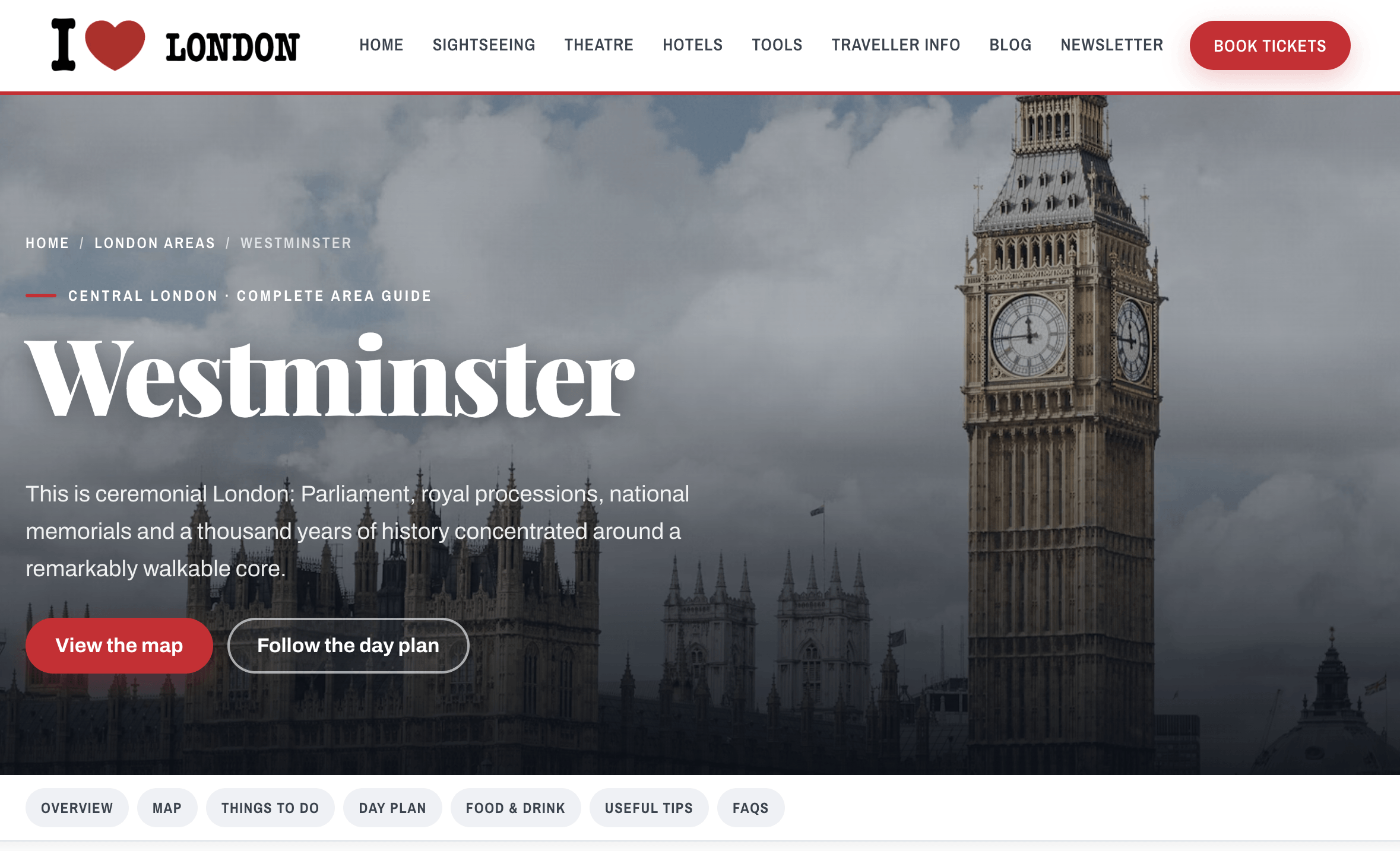
The Westminster guide. All 35 areas follow the same structure, so you always know where to look.
13 with access + 1 free
Tools 1–13, including the Historic London Pub Finder, are included with paid access. Tool 14, the London Emergency & Healthcare Card, remains free for everyone.
Estimate food, travel, attractions and entertainment costs.
Compare routes and costs from London’s six airports.
Estimate pay-as-you-go fares and daily caps.
Compare selected Tube journeys with walking time and distance.
Check the fare zone for stations and neighbourhoods.
Compare attraction prices with the cost of a sightseeing pass.
Work through London transport options for younger visitors.
Compare storage choices near major London stations.
Work out what, if anything, to tip in restaurants, pubs, taxis and hotels.
Total your paid attractions alongside London’s free museums.
Build a month-specific packing list from Heathrow climate averages and your trip length.
Record explored areas, save places for later and see private progress across all 35 guides.
Explore 60 curated historic pubs, find nearby choices and save pub IDs privately in your browser.
Essential numbers, NHS service guidance and a printable personal emergency card.
Open the free tool →New with access
Use genuine tourist offers verified on official provider and official partner websites. Each listing shows the price, saving, availability, conditions and official booking link.
London discounts are refreshed monthly and checked weekly, so you can purchase access while planning your trip and return closer to your visit for the latest available offers.
The advertised offer count and savings relate to current offers and may change. The £32.39 total uses 3 compatible fixed-price offers. Other listed savings use dynamic prices or require age, disability, family or qualifying National Rail eligibility, so they are not added to that total.
Get access — £4.99Good to know
Already purchased? Open the private access link in your confirmation email. Get help with access →
No. You pay £4.99 once for the guides, paid planning tools and London discounts. There is no automatic renewal or scheduled expiry.
Your private access link appears on this page after payment is confirmed. A copy is also sent to your PayPal email address. Save the link so you can return later, and keep it private.
Yes. Open your private access link on the device you want to use. You can also add the site to your phone’s Home Screen for quick access.
Prepare your guides and tools while connected, and wait for the offline-ready message before travelling. Downloads are saved on that device. Live discounts, external websites and booking links need an internet connection.
Yes. The London Emergency & Healthcare Card is free for everyone. Explore the area guide listings to see which neighbourhoods are covered.
Contact us with your PayPal order details so we can help. See our Refund Policy for information about refunds and your rights.